Where octopuses hang from walls
Danko the postman squeezed his left eye, aimed and, curling his fist inward and flipping it forward, sent the coarse brown envelope swooshing over the hedge like a Frisbee. The envelope drew an arc in the air and finished its majestic flight with a loud smack against the window of the two-story whitewashed house. The sound sent threads of electric shock up Danko’s old and slightly crooked spine. He hurried to mount his rusty yellow motorbike and, missing the starter lever a few times, dropped his shoe. He glanced around for it, couldn’t find it, cursed under his breath and, having finally thrummed the motor back to life, disappeared down the hill in a cloud of black smoke.
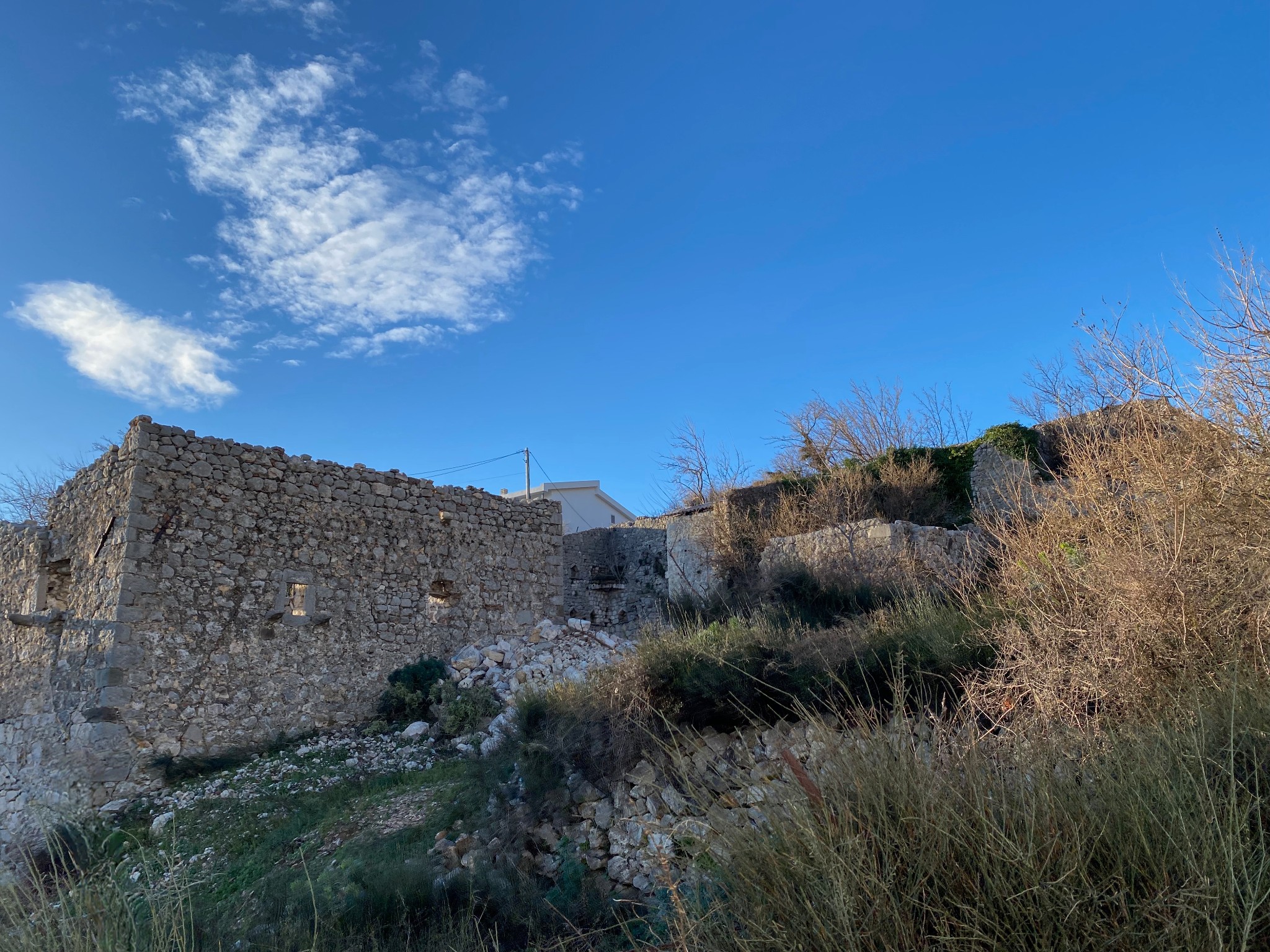
The purple house they called it, even though the lone tall building at the end of an uphill road was impeccably white. It was separated from the rest of the village by an abandoned plot with ancient dilapidated stone walls between which tall yellow grass was rustling in the wind under the fragments of a fallen roof.
Danko glanced at the white walls that wobbled like jelly in the shaky triangle of his broken rearview mirror. He considered crossing himself for protection, but the downhill road was too steep, and so he kept both of his hands on the handles and just cursed instead. The wicked white walls finally slid away from his mirror. Danko turned off his motor and, pulled by the force of the incline, glided past two more empty houses, whose shutters were sealed and gardens consumed by thorny jungles.
Danko drifted into the next yard through open rusty gates. The low and wide house was pale pink, bleached not by design but by years of sunshine. A chaotic web of cement streaks ran across the walls, covering those places where rains leaked through in winter.
“Shit. Here goes another one,” someone muttered on the roof.
An orange roof tile, like an exotic leaf, shot past Danko’s face, just missing it. The tile smashed against the concrete of the driveway into a mosaic of uneven, jagged fragments.
“Oi, Marko,” Danko shouted, tilting his head up. “You there?”
A glistening mustached face appeared above the edge of the roof and grinned.
“Oh, look who’s here,” the man said, showing a wide, gappy smile. “Danko, what’s up, mate?” The man’s smile quickly dropped. “What’s wrong with you? You’re sick? You don’t look good. Your face’s funny.”
Danko wiped off the tickling perspiration from his forehead.
“Can I use your toilet, Marko?” he asked.
Marko crawled closer to the edge, knocking more tiles along the way. They clattered down the roof and smashed in front of the porch.
“Damn it,” Marko muttered, inspecting the damage before turning his gaze back to Danko. “Sure, mate, go ahead. Did you help yourself to the neighbors’ pomegranates again? I told you: they spray them. You know I told you. You know I saw them do this… Hey, what’s with one shoe?”
Danko didn’t reply but hurried, limping through the entrance door.
When he got out, his fingers still trembled, fumbling with the buckle of the belt.
“That damn house, Marko…” he said.
Marko had already climbed down from the roof and was now raking away the tile fragments.
“What?” Marko asked. “The purple one?” He stopped raking. “It stole your shoe, didn’t it? I told you: just drop their newspapers at the gates and be off. What are you chilling there for? You know they’re cursed–”
“I wasn’t chilling,” Danko said, pushing tile fragments with the tip of his remaining shoe toward the growing pile. “I do drop their newspapers at the gates.”
“Then what?”
Danko caught his friend’s look and took in a deep breath.
“Someone sent them a letter,” he said.
Marko stopped scraping his rake against the concrete.
“Who would want to send them a letter?” he asked, watching Danko’s face.
Danko shrugged.
“The last name’s the same,” he said after a while.
Marko’s arm flew up like a ribbon caught in the wind. The tips of his fingers performed the ancient sign of the cross in front of his chest. He instantly felt better.
“You mean,” he said, still staring at Danko’s face, “there are more of them?”
Danko’s stomach rumbled. “Let’s not talk about them,” he offered. “What’s with the roof tiles?”
Marko looked down and started to clean his yard again. “You won’t like this,” he said.
“I won’t like your new roof tiles?” Danko asked and scanned the edge of the roof.
Marko shook his head. “No,” he said, hiding his eyes from Danko. “You won’t like where I got the tiles.”
Danko slapped his thigh, hissing.
“You went to the ruins again,” he said. “Why, Marko? Didn’t you see the moon was bright? Who on earth goes anywhere near the purple house when the moon is bright?”
Marko drove his rake into the ground and chipped a piece of concrete.
“What do you want me to do, Danko? My roof leaks so much I can take showers in my living room. You bet the moon was bright. That’s how I could see the tiles–”
“I bet you could see a lot more than that…”
They locked eyes, and for a moment it was quiet. Marko sighed.
“What did you see this time, Marko?” Danko asked.
“An octopus.”
Danko blinked. “Huh?”
“I saw an octopus,” Marko repeated. “It hung from the top window, like a rag, swaying, clinging to the wall, glistening…” Marko shuddered.
“And the house?” Danko asked.
Marko nodded.
“It got completely purple,” he said. His voice caught. He started dragging his rake over the empty concrete, then raised his eyes and looked Danko directly in the face. “The moon laughed again.”
Danko felt snakes writhing in his belly.
“I think my shift’s done for today,” he said, clutching his stomach. He limped back inside, stealing one look toward the hill. The purple house wasn’t visible from Marko’s garden, but Danko felt its fake white walls were watching them.
Inside the tall white house, the morning sun colored the kitchen golden. The rays, caught in the round glass teapot, danced like crystal sparks. The spirals of steam rose up along the thin gauze curtains toward the heavy wooden lamp on the ceiling.
A woman sighed.
“You think he’s coming?” a white-haired man with a long beard asked from his armchair in the living room. In the mornings the house was quiet, so the woman could easily hear him all the way from the kitchen. She shrugged. He didn’t see her, but he knew her answer. He unfolded a letter and spread it on his knee again. The white paper glowed, reflecting light as he reread one specific line through his thick magnifying glass on a chipped handle.
“I hope he’s really coming,” he repeated.
The woman placed a plate with raisin muffins on a tray next to the two cups whose thin porcelain walls let the sun through like seashells. She slowly lifted the load and, calculating each step, walked with the tray toward the room. They both acted like they couldn’t hear the cups clink on their saucers. It had been a while since her hands had started shaking, but recently she had broken the other two cups from the set when she misjudged the distance to the wooden table where they took their tea.
The tray touched the surface noiselessly. And as the cups stopped clinking, they both let out a breath.
“I don’t know, Vic,” the woman said, picking her cup up. Her knuckles bulged when she clasped the thin handle. She winced. She had bought these cups when they were both much younger. Who would have thought back then that one day it would hurt her to lift her own cup?
“He says that he’s coming, doesn’t he?” she said. “That’s what his letter says. So I guess he is.”
The man growled, as if it was enough of a reply, then added, “He said it many times before.”
Sonya blew away the steam from her cup and watched it fly toward the window. “He gave the date this time,” she said. “I think he’s really coming.” She sipped her tea, then slowly put it down and rose from the table.
“Besides,” she said, walking toward an ancient coffee table whose wooden legs bore the weight of towering newspaper stacks, “there’s this.” She picked up the top newspaper from the stack and slowly walked back with it.
“This flew in across the hedge a few days ago,” she said, placing the newspaper in front of him.
Vic smirked. He picked up the newspaper and found the title she had circled with a pencil. He grimaced as if he had a pang of toothache.
“They chewed him up, didn’t they?” He shrugged, avoiding looking at his wife. “Aren’t those art critiques always vicious, though? It’s their job.”
Sonya gazed through the window where the thin line of the train was crossing the distant field.
“No,” she said, moving her head slowly. “They used to praise his work before.”
Emil rode the morning train, resting his forehead against the cool, trembling window. The low sun flashed between the trees, throwing sharp shadows onto the train. Through his closed eyelids Emil saw red flashes switch off to black and then to red again. He chose the morning ride not because he believed in early rising, or hurried to arrive – he didn’t and he wasn’t. Emil just lost his sleep.
It started a while ago, then gradually progressed. At first, his nights shredded into fragmented dreams interrupted by tiring fidgeting between the covers. Then time turned to jelly, stretching through dark eternities until dawn. Now he no longer went to bed at all. Holding his pencil, he’d sit still like a statue beneath his table lamp, his sketchpad open, its blank pages gaping like a hungry mouth demanding shapes and lines he could no longer summon.
Now, on the train, the stiff, unyielding seat pressed against his back. He shifted and the sharp angle of the envelope in his pocket poked at his side. Emil traced the edge of his aunt’s photograph.
She had written to him every midsummer for his birthday. Over the years her steady, predictable handwriting – done always in pencil, so that she could correct any mistakes – degraded into erratic lines, as if her pencil had been escaping from insects across the paper. This year, there was no letter, but only the photo with a brief invitation on the back.
The picture showed his aunt in front of the house. Even though Emil hadn’t been inside those walls in decades, the memories only grew sharper. His fingers tapped the air as if touching the tops of the tiny plastic toys he used to line up on his bedroom shelf. They were strange little monsters: a puppy with wings, a cat with three eyes, a whale on legs. He’d never encountered such figurines again before or after. Emil now wondered where on earth his uncle bought the chocolate eggs that held such toys. He couldn’t remember the wrapping or the chocolate.
Right next to that shelf was his bedroom window with a rope ladder always under it, so that he could climb down directly into the garden where glossy leaves shook in the wind.
Emil smiled. Everything in that house seemed veiled in that kind of wonder that only childhood memories could hold. In fact, it was in that house that he had first picked up his aunt’s pencil and started sketching on the margins of her newspapers. He sighed. He probably slept perfectly back then.
The night the photograph arrived, exhaustion had finally won. Emil fell asleep beneath his table lamp. The feverish dream brought no relief. He saw his aunt’s house, but the white walls had grown teeth under its ground-floor window. With hedge shrubs tangled in its gaping mouth, the house lisped, spitting the glossy leaves. It rasped to him: “Things fall apart when they’re not taken care of.”
The train entered a tunnel, and Emil let out a long, pained sigh. The house wouldn’t restore his talent or his reputation, but he had to at least try and find some peace before the last fragments of his mind wore away. Inside the tunnel, the red stopped flashing under his eyelids. The concrete walls muffled the clacking of the wheels, turning it into a monotonous deep hum. In the dark, blue glistening tentacles slid down a tall white wall. Emil shuddered and snapped wide awake.
The tunnel ended, blinding him with light. Across the window ran endless golden fields. Rolling hills appeared ahead. Even from all this distance, Emil could see the white dot of the house glow above the village. His carriage lurched once; the train began to drop its speed.
Goats hopped up the wall of the locked train station house. Through the hole in the roof they jumped inside in search of shrubs that hadn’t yet been discovered by other goats.
Emil hopped down from the train onto the gravel. Dragging his suitcase to the edge, he let it drop into his arms. The station had no platform. The goats froze on the roof, watching him. The train hooted once, slid its doors shut and started rolling away. After it had disappeared behind the next hill, the field became empty and quiet. A goat bleated on the roof, another goat replied, and then they all dropped their heads and resumed grazing.
A tiny wheel broke off the suitcase almost immediately after Emil started pulling it across the field toward the dirt road. He sighed and looked up the hill. His aunt and uncle didn’t have a car. He wondered if he was even capable of that climb after so many sleepless nights.
Marko whistled behind the steering wheel. His car glided noiselessly down the hill, engine off. Through the rolled-down window, the October sun warmed his bristled cheek. The clear, pale sky promised no rain. He still had time to repair his roof, and do so safely now that he had resorted to helping himself to state property. Nobody used that station house anyway, except the goats, but those didn’t feed on tiles. He called it not theft, but rearrangement of material.
Marko spotted someone down the road, obviously a stranger – the shirt too white. Besides, the poor bugger was dragging a sleek broken suitcase up the hill.
Marko turned his steering wheel and rolled toward the young man.
“Need a ride?” he asked, sticking his head out.
The stranger flashed a perfect smile. “I’m going in the opposite direction,” he said.
“There’s no opposite direction for those who want to help,” Marko stated, already backing up his car to head the other way. He veered to Emil, almost knocking the suitcase over in the process.
“Hop in,” Marko said. “Shove your suitcase onto the backseat. Just move my clutter to the side.” With this Marko leaned back himself and rattled inside the crates through shovels and metal rods. A rake poked out and bumped Emil on his knee.
“Really, it’s fine,” Emil said. “My suitcase fits just fine there.”
One of the crates dropped, scattering its contents around the floor. Marko nodded, satisfied, and waved Emil in.
“Which way?” he asked.
Emil slid into the front seat. Sinking into the worn and soft upholstery, he let out a sigh, dropped his shoulders, and said, “All the way up, actually.”
The grin vanished from Marko’s face.
“How do you mean all the way up?” he asked, and a twitch ran across his bristled cheek.
“Oh… I’m sorry,” Emil said, raising both his hands. “You’re right: it’s a long way. I should have known better. Anywhere up along this road will be a big help, thank you.”
The man didn’t reply. Instead he shoved the stick into gear, squeezed the steering wheel, and hit the gas.
Emil bumped against the back of the seat and sneaked a look at the driver. The man stared straight ahead, his eyes bulging and unblinking. Emil combed his exhausted mind for any ice-breakers.
“The autumn seems mild this year–” he started.
“You’re the one with the same last name,” the driver said to him.
“I’m sorry, what?” Emil asked. He wanted to laugh, but saw the man’s face and didn’t. “Same name as whose?”
“You’re going to the purple house,” the man said, as if stating a fact more to himself than to Emil.
Emil drew in a careful breath, sniffing. It dawned on him that he might have accepted a ride from someone heavily intoxicated.
“From what I remember,” Emil said quietly, hoping not to agitate the driver any further, “my aunt’s house is purely white.”
The man nodded. “Just as I thought,” he said, spitting three times over his left shoulder.
Emil coughed. “You thought my aunt’s house was white, sir?” he asked.
The man shook his head. “It’s purple,” he said and slammed the brakes.
The car jolted to a halt near the row of lean tall cypresses. Their tips waved slightly in the wind as if pointing to all the distance Emil had yet to cover. Emil dragged his suitcase from the backseat.
“Thank you,” he said, pausing. “Drive carefully, all right?”
The man mumbled something, avoiding Emil’s eyes.
“I didn’t get that,” Emil said, not smiling anymore.
“Watch your shoes,” the man said louder, putting the car in neutral and sliding backward downhill.
Emil stood staring at his shoes. He wasn’t sure whether the man had really said those words or if sleep deprivation was catching up with him, and he was now hallucinating.
Regardless, Emil spent most of the following half hour watching his shoes while pushing uphill. Looking down spared him from the sight of the ruins that shielded his aunt’s house from view. The broken stone walls seemed to remain stubbornly in place, no matter how many steps he took. When the white walls finally shimmered behind them, he laughed. He had spent years deciphering tones and colors, so now he had to agree with the driver: the walls did turn to a shade of purple where the ruins cast their shadows.
Just when he thought his journey was nearly over, his suitcase lost one more wheel. A shockwave bumped through his shoulder when his suitcase slid into a hole in the dirt road. The wheel broke off and rattled down the hill. Emil spun around to catch it, but twisted his ankle, yelped, and dropped onto the ground. He clutched his foot and discovered that his shoe was gone. He turned around to pick it up, but it was nowhere to be seen.
Emil got up slowly, scanning the ground. There was an indentation in the road, as if someone had stamped the ground with a manhole cover. He wondered what could have created such a perfect circle. A voice cut through his thoughts.
“You have arrived!”
His uncle leaned out from the top window, his white beard flying in the wind.
Emil waved back at him.
“I was hypnotized into losing my shoe,” he shouted, laughing.
His uncle went still for a moment. Then the gate creaked and Emil’s aunt walked out.
Emil’s first thought was that she had gotten smaller. She had never been tall, but now she seemed to have dried to a twig. Emil stared at her walking cane.
“Poor baby,” his aunt said, stretching her arms to him. And although he was a grown man, and they both knew it, at that moment he felt how true it was. A lump rose in his throat and his eyes prickled. He bent down low to hug his aunt.
She patted his back, as if lulling him to sleep, and then, without letting go, said over her shoulder, “We have to do something about that damn hole, Vic.”
His uncle nodded. “Tonight we will,” he said.
Emil raised his eyebrows, but then remembered that his aunt and uncle often worked in the garden at night. As a kid, he’d be falling asleep to the sound of them clattering, grunting, dropping things under his window. They used to say it was too hot to work during the day. Only, that was during his summer holidays, not in October.
Emil took off his remaining shoe and, rolling his now two-wheeled suitcase, limped into the garden barefoot. From the photograph, he knew that nothing had changed there since he last visited. He smiled at the rope ladder still hanging from the window. The photograph, though, showed only the left part of the view. Emil looked to the right and froze.
“What is this?” he asked.
His aunt glanced at her husband, raising her eyebrow in a silent question.
“Is it an art installation?” Emil asked again, still holding his shoe and now pointing with it to the right.
There, along the side of an old wooden shed, behind a handcart, towered a pile of shoes.
“Are you… collecting those?” Emil asked. The driver’s face came to his mind. “Have you stolen them? Am I hallucinating?”
His aunt hurried to pat his arm. “No, of course not. All is fine. You’re not hallucinating–”
“And,” his uncle added from the window, “we haven’t stolen them.”
“This is just a…” Aunt Sonya pointed her cane toward the dirt road, but then blinked as if she had forgotten words.
“A project,” Uncle Vic said for her. “This is our maintenance project.”
Emil glanced at the road again, and then back at the shoes. The soles of some shoes flipped open. All of them looked worn and torn, and none seemed to have a pair.
“So… are you repairing them?” Emil asked.
His aunt was pulling him by the sleeve.
“Not really,” his uncle said from the window. “But you can add your shoe to the pile.”
His aunt winced and looked at her husband. “Vic, not now,” she said.
Emil chuckled. “Thanks, but I’d rather keep it. I’ll find my other shoe later.”
His uncle laughed, waving him off. “Fat chance,” he said.
“Vic, just stop talking,” his aunt said.
Uncle Vic brought his fingers to his mouth. “Sure,” he said to Emil. “You do you. Go search for it. I mean, if you want to… Why not? We all should follow our dreams.”
Aunt Sonya groaned, shaking her head.
“Let’s go inside,” she said. “We’ll find you some flip-flops.”
Emil would have loved to say that nothing had changed inside. The muffins waited on the wooden table near the window. Hot tea filled the same cups, but one was chipped. Aunt Sonya said she couldn’t replace that one because she had already broken the others in the set. Uncle Vic was the one who had brought the tray with the teapot and the cups. Emil raised his eyebrow, but Aunt Sonya only sighed and shrugged. Her walking cane was propped against her chair.
“So…” Emil said, nodding at the cane. “How are things with you?”
Aunt Sonya just smiled while Uncle Vic took a long sip, staring through the window.
“You know,” his aunt finally said, “some things fall apart, whether you take care of them or not.”
This sounded familiar, but he couldn’t quite place where he had heard that.
“How bad is it?” he asked.
His aunt and uncle exchanged looks. Aunt Sonya placed her cup down and folded her hands on her knees.
“Well,” she said. “I can no longer… do some things.” She looked at him. “I can no longer take proper care of the house. Which is a shame. I always enjoyed doing it.”
Uncle Vic grunted and nudged a muffin her way.
“But this is okay,” his uncle said, “because I can take care of the house.”
Aunt Sonya shook her head.
“This too won’t last forever,” she said.
The silence hung above the wooden table. Emil rolled his shoulders, trying to spread the weight. His chair creaked. They all acted like they couldn’t hear it.
“You’re both not that old,” he finally said and winced. The words had helped nothing.
Aunt Sonya smiled.
“What?” Emil asked.
She tilted her head, as if deciding, glanced at her husband and turned to Emil.
“We’d like you to take over,” she said, catching his eye, “at some point.”
Emil turned away and bit into his muffin. His aunt lifted the teapot slowly, and carefully, supporting the bottom with her other hand, poured more tea into his cup.
“What exactly do you have in mind?” Emil asked, still chewing.
His uncle patted the wooden wall as if it was a pet.
“You want me to move in here?” Emil asked. The ruins, the goats on the roof, the strange driver passed through his mind. His eyes skipped along the wall, searching for the right words to explain.
“It’s okay,” his aunt said before he could speak. “You don’t have to. We know you have a busy life in the city.”
Emil let out a bitter laugh and gulped more of his tea.
His uncle glanced at the newspapers in the corner.
“It will pass,” he said. “Those are just art critics. It’s their job–”
“Vic, don’t,” Aunt Sonya said.
Emil shut his eyes as whole paragraphs passed through his mind.
“Is it okay if I go lie down?” he asked.
His aunt pressed her lips in a smile and nodded, picking up her cane.
“I’ll get you some fresh linens,” she said.
Upstairs in his old bedroom, Emil first went not to his bed, but to his toy collection. Placed in a row on a polished shelf, they looked much smaller than he remembered. He touched the pointy plastic ears, and felt the sharp edges drive into his skin with a familiar bite. His grin faded when he reached the final one in the row.
“I don’t remember this one,” he said, his hand suspended above a blue plastic octopus with tentacles entangled in a knot.
His aunt dropped the pile of bedsheets onto the chair and craned her neck to see.
“Oh, this one is new,” she said. “We got this poor thing only recently.”
Emil threw his head back laughing.
“You’re still collecting them?” He raised the toy to his eyes, bending the tiny knots with his thumb. The tentacles slowly curled back in place. “You know what’s funny?” Emil said.
“What?” his aunt asked, picking the toy out of his hand and placing it back on the shelf.
“When I was on the train,” Emil said, “I saw an octopus… Like it was a dream, or a vision.” He smiled, looking at the toy. “I don’t really sleep much these days,” he said.
His aunt walked up to him, her cane now adding a new sound to the familiar creaking of the floorboards. She put her bony arm around his waist.
“Maybe it was the house calling for you,” she said. Emil looked down at her but saw that she was joking. She winked at him and he laughed.
“You’ll sleep better here,” she said, then patted his back and left the room.
The air flew in, lifting the thin gauze curtains. Driven by the wind, the rope ladder clacked under the window. Emil rolled it in to stop the sound. Now he could hear only the rustling of the leaves outside. His uncle grunted somewhere in the garden. A single metal bang came, then another one. Emil looked out. His uncle was throwing the shoes into the handcart. Emil was sure that he’d seen his remaining shoe fly in.
He shook his head and rubbed his eyes. His eyelids grew heavy with each blink, as if molten lead was being poured inside. Pleasant soft fog poured into his head. Emil climbed into his bed, still afraid to give in to the hope. Old rusty springs creaked a familiar tune. Emil smiled and slid into the mute darkness for the first time in months, barely aware of the purple shadows trembling on the walls.
Laughter yanked him from his sleep – a burst of high-pitched, rolling giggles.
“What the hell?” Emil mumbled, blinking the sleep away. The dream wouldn’t let go; someone was hiccuping through fits of laughter. Emil rubbed his eyes, rising on his elbow. Through the open window, the giggles flew in again. He looked out – the night had fallen, but it wasn’t dark. The air was purple. The moonlight poured over the walls, the curtains, the ceiling, filling the floor, his bed, and the shelves with glowing purple light. On the shelves the plastic figurines grew larger and were now moving. The three-eyed kitten stretched and yawned, and the whale danced. The octopus was rolling hopelessly like a ball, its tentacles still entangled.
“It’s been a while,” Emil whispered, afraid to knock himself out of the dream.
He took a few careful steps to the window just to hear the next burst of laughter. He scanned the garden, but only the purple shadows danced along the hedge. The branches shook, as if something was stuck inside. Emil looked up, and there, up in the purple sky, he saw the Moon that stared at him. The Moon grinned at him with all its shadows, lines and craters, and then it had just a moment to wink at him before three black bats, thin and transparent like sheets of plastic, flew up to its sides and tickled them with their wings. The Moon squeezed its eyes shut and rolled with laughter.
“Dear, are you up?” A familiar voice flew from the road. “You don’t mind lending a hand, do you?” his aunt asked.
Emil hopped onto his windowsill and looked across the hedge. His aunt and uncle were hurling shoes into the gaping hole in the ground. Emil squinted, trying to figure out what the white shades were that slid along the edges of the hole. He gasped. Those were teeth.
The perfect circle of the jaws snapped once and opened up again to gulp down a new oncoming shoe.
“What’s going on?” Emil shouted.
His uncle rolled the handcart closer, unloading a new batch of shoes near the hole.
“Can you please climb down,” he said, “and free that poor thing from the hedge?”
His aunt shoved another shoe into the hole. The hole made a munching sound. A fat pink tongue slid out and slurped the remaining pile in.
“What poor thing?” Emil asked.
His aunt uncurled her spine and grimaced.
“There’s something stuck in the bush,” she shouted, pointing.
The hedge shook once again to the hysterical giggles of the Moon. Emil felt for the ropes of the ladder.
“Sure thing,” he said, now chuckling too. The rungs felt slick and cold under his fingertips as he climbed down the purple wall. The thing in the hedge now whined and whistled like a chew toy. Two bulging golden eyes with horizontal pupils stared at Emil from the bush.
“It’s some kind of monster,” Emil shouted.
“Duh,” his uncle shouted back. The hole had just slurped in another portion.
“What color?” asked his aunt.
Emil peered closer. Two tentacles spread out toward him.
“Pink,” he said.
More munching followed across the hedge. His aunt grunted, scraping more shoes in.
“Just as I thought,” she said. “Try untangling it, dear. Don’t worry, it doesn’t bite.”
His uncle laughed.
“It just squirts ink,” he said. “Mind your eyes.”
Carefully, moving the branches away and snapping off some thinner twigs, Emil freed one tentacle, and then another. He heard a shovel scrape the metal handcart and the final slurp. The last shoe had just been fed.
His aunt and uncle walked up to him while he was holding the writhing pink blob, some tentacles still entangled.
“Good job,” his aunt said with a nod. “Now bring this pink one to the blue one.”
“Uh-oh,” his uncle said, pointing at the window. “It’s trying to escape again.”
The ladder knocked against the wall under the weight of the blue octopus that clung to the trembling ropes with its blue knots.
“Vic, you go catch it,” Aunt Sonya said, “and we’ll bring the pink one upstairs.”
In his bedroom, Emil placed the pink octopus on the shelf.
“They miss each other,” his aunt said, patting the creature’s head. “But I can’t yet untangle the blue one.” She wiggled her bulging knuckles. “I’m working on it.” She hurried to smile. “One knot at a time, right?” She winked.
Emil nodded, untangling the most stubborn knots.
“Is that the thing you can no longer take care of?” he asked.
His aunt shrugged, without answering straight away.
“Yes, that one,” she said eventually, “and many others too.”
The Moon squeaked with laughter. Aunt Sonya nodded toward the sky.
“I can’t chase the bats away, for example,” she said. “When the Moon gets too bright and full, it attracts all kinds of things.”
“Like, that hole?” Emil asked.
Aunt Sonya groaned, shaking her head.
“Right,” she said. “But that one is stuffed now. No more biting shoes off passers-by any time soon.”
Uncle Vic walked in carrying the blue octopus. He plopped the blob next to the pink one. The two slid closer to each other like soap bubbles.
His aunt sighed.
“All done for tonight,” she said. “Let’s have some tea?”
Emil looked out of the window. He drew in more of the purple air and looked at the laughing Moon.
“This is a good dream,” he said. “I want to stay here and watch some more.”
“Sure,” his uncle said. “You do you.”
The morning sunshine danced on his cheek and woke him up. He wanted to turn to the other side, but then sat up straight and blinked. He squinted at the window, checked the walls, then hopped out of his bed as if his sheets were on fire. After rummaging through his broken suitcase and throwing out everything it held, he finally dug out his sketchpad.
The ray of sun crept along the floor. It slid across Emil’s knee, unnoticed. It brushed across the wall, and then the shelf. If Emil had looked up, he would have seen the purple shadows that the ray was leaving. But Emil couldn’t see the shadows, or the new pink figurine on his shelf, because crouched on the floor, barefoot and bent over his sketchpad, Emil was drawing.