The wind
Things didn’t go right from the very beginning. Mr. Valerian Tudori, his baby face shaved squeaky clean, his dimples ready, hopped down the aircraft steps, and almost moaned with pleasure as the soles of his shoes bounced against the tarmac. It must have been the whiff of that wilderness and freedom – the slogan of his own creation – that leaked into his brain. For the thing was, Mr. Valerian Tudori, though still quite young and fairly sporty, usually took his job too seriously to hop in front of anyone who drove directly to the plane to greet him. Valerian threw a haunted look at a mountain of a man locked in a business suit and commanded his dimples to stay in place.
“Anemon Agriani,” the man said, reaching out for a handshake to the protest of the stitches in his suit, “the mayor.”
People of this build squeezed hands like sponges, so Valerian composed himself in order not to wince, and then winced anyway. It wasn’t the handshake though – confident but almost caring – that contorted his neatly arranged expression into a grimace, but the flashes from the mayor’s mirrored sunglasses.
Was that the sun reflecting, though? Could he, in his uncomfortably altered state of mind, have missed cameras nearby? What would the board think if they saw the photos of him hopping? The chairman, undoubtedly, would roll his eyes – the guy had grown visibly hostile in recent days. Valerian, given the current situation, didn’t have the luxury of losing a single vote.
With all the white noise in his head, he gave up trying to decipher the mayor’s excited and weirdly high-pitched babble behind the wheel of an old but surprisingly quiet Renault. Instead, he focused on the hypnotic motion of the hunchbacked car as it gulped the ancient road, turn after turn, sliding down toward the sea.
This road became the only way to reach the town after its railroad rusted through and got dismantled bolt by bolt. Now, the gaping mouth of the train tunnel provided shelter for the town’s cows.
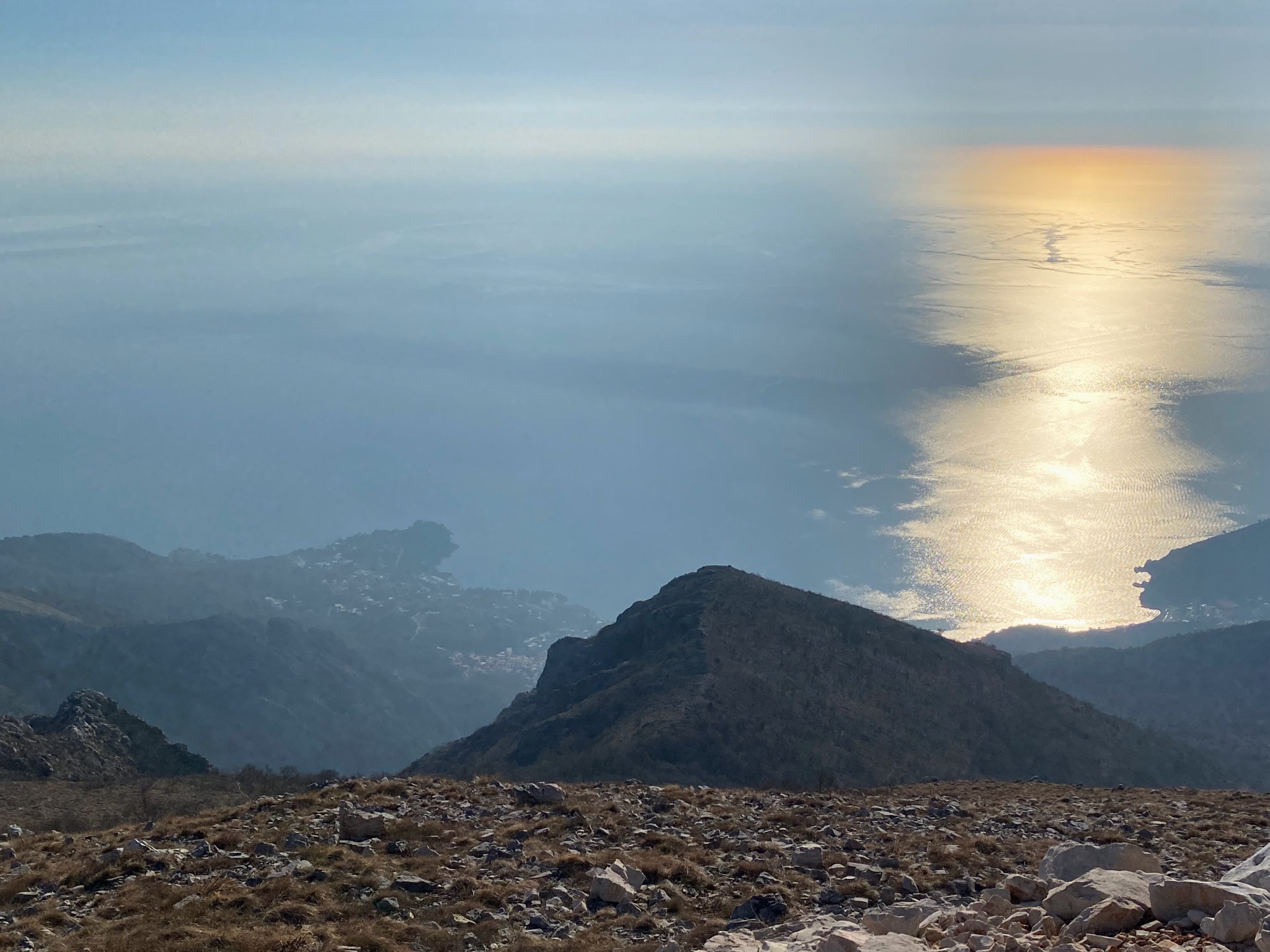
Valerian watched the sunlight glimmer on the surface of the sea. It was a rare view to catch – one had to rise above the water at a certain hour to see the golden light turn half the sea into a gigantic blinding mirror. He first discovered this effect a long time ago, on a school break in his grandma’s village – a place that no longer existed. That evening, he climbed a mountain above the village and stood transfixed by what he saw. The overwhelming joy at having witnessed something so extraordinary now echoed in his chest. Lately, he often thought of that old house on the beach, filled with the scent of zucchini pancakes, geraniums and salty air.
His grandma had long been gone. She didn’t get the chance to die in the old house. His parents took her in because she left her dinner on the stove one day and forgot all about it. She managed to run out when she saw the flames but the house got badly burned. She fought with his parents about the fate of the house but, as she put it – when you are close to either edge of your lifeline, your choices tend to lose their battles. She finally agreed to sell the land – luckily, investors had been drooling over the spot for years – but only on one condition: the money would be deposited into Valerian’s account.
“So you can do something worthwhile with it some day,” she said.
It was these funds that got him the shares of Magic Land Inc., the company where he now worked. His grandma didn’t live to see the day. Their final meeting happened when she asked to be taken back to her land, even though construction work had started by that time. There, sitting on a scorched chair, among the dangling grapevines that used to be her garden, near a crater that stared back at her, she listened to something only she could hear and didn’t move at all.
The patch became a popular resort. Valerian’s wife, Nika Tudori, kept offering to go there. They traveled to other places instead.
The jellied air inside the old Renault shifted. It took Valerian a moment to realize that he’d been asked a question. He hadn’t heard a word of it.
“I’m sorry, Mr. Anemon,” he said. “I must have been lulled by your silent car. I didn’t know old timers had such quiet engines.”
“They don’t,” the mayor said, hulking over the steering wheel. “But they have sticks.”
“What sticks?”
“It’s in neutral.”
“You mean –”
“Destiny is pulling us toward itself,” the mayor said, glancing across his shoulder at Valerian, his mirrored sunglasses sparkling like a disco ball.
Valerian grabbed the front seat and scanned the road ahead for traffic. Fortunately, it was a truly deserted route.
“So the car is rolling down out of control,” Valerian said, to which the mayor veered to the cliff’s edge and back to demonstrate how much control he still had, causing Valerian to tumble in the back like unsecured cargo. Would his insurance cover the search party to retrieve their bodies from the sea?
“It’s our air,” the mayor said when he was through.
“Excuse me?”
“Our air got into your head. Distracted you. It does things like that,” the mayor said, adding, “Wait till the wind comes. You might enjoy it.”
Valerian held his breath because here it was, the very topic he came to discuss. Was it the right moment for the conversation? This vintage tin can on four wheels wasn’t exactly the conference room at the Magic Land Hotel. Still, could he afford to miss the chance to salvage the whole project? His heart began to thump.
“Actually, Mr. Anemon,” Valerian said, making sure not to clear his throat or display any other of his neurotic gestures, “there seems to be a bit too much enjoyment of the wind in this town, don’t you think?”
“Maybe you need some of it, Mr. Valerian?” The mayor raised his sunglasses to wink at the rear-view mirror. “Don’t you think?”
“A naked mayhem in the central square?”
“Is that what your press called it?”
“What else could you call it?”
“It’s a tradition,” the mayor said and nodded, “the one that people desperately need.”
“Mr. Anemon, nobody disputes the importance of community traditions. They are usually good for tourism,” Valerian paused, searching for a milder way to put it and found none, “but going completely bonkers in front of tourists is not good for tourism.”
“Listen, this wind does literally drive you crazy. What can you do? Just catch the current and enjoy the ride,” the mayor said and before Valerian could react, he added, “Those who fight the current, drown. You know this, right?”
Valerian sat back and rubbed his temples. This was going to be harder than he’d expected.
“You see,” Valerian said, trying to keep his tone respectful but firm, “no company would risk their investments for a place that’s out of control.”
“Why not?”
“Are you kidding me?” Valerian blurted out. “You’re scaring tourists off. That’s why.”
He pulled out his phone to read from the screen:
“A professor chased by a stranger in a dino costume.”
The mayor snorted, then burst into a hearty laughter.
“You find it funny?” Valerian asked.
The mayor nodded, his laughter reverberating through the car. “You should have seen this,” he wheezed, between his laughs, “that poor paleontologist running from a T-Rex down the central square.”
Valerian shook his head, mainly to hide a creeping grin.
Anemon Agriani took a few noisy breaths, struggling to suppress his laughter. “The best part,” he said, “is that he probably never expected the bones that he’d collected to come in handy for an escape.” At this, his laughter reached a high-pitched squeak, causing Valerian to laugh along.
“Mr. Anemon, this is too much,” Valerian said, sensing little conviction in his words. “Just think about that elderly couple.”
“What couple?” the mayor asked, still chuckling and wiping away his tears.
“The one who had to sail back home with fifty cats on board.”
“Oh, it’s Simeon Guattari’s doing,” the mayor waved his hand dismissively. “The cats used to steal food from his cafe. It’s on the highest street in town, with a majestic view, by the way. We really should go there sometime—”
“Mr. Mayor.”
“Right. So Guattari would chase the cats off. This old lady and her cranky man reported him for animal abuse.”
“So he loaded those cats onto their yacht?”
“Not only those cats, but all the cats in town,” the mayor sighed, relieved to have stopped laughing. “I suppose he figured they liked them more than he did.”
“Mr. Anemon,” Valerian leaned forward, “actions like these have to be punished, at least symbolically. It’s about sending the right message, if not for Guattari then for tourists.”
The mayor shook his head.
“The only message for the time of wind is to go with the flow and have fun.”
Valerian slumped back in his seat. The car made another turn, descending into a leafy forest. The shade helped calm his racing thoughts. There had to be a way to convince this oddball. He just needed to find the right words.
“Mr. Mayor,” he began again, “for our partnership to continue, the company has to see that you have this wind situation under control.”
“How does one control the wind?” the mayor asked.
“Not the wind,” Valerian slapped his thigh. “I know you can’t control the wind.”
“Good,” the mayor said, jerking the car to the right.
The engine woke up and revved as the car staggered up a dirt road so narrow that Valerian had to pull in his elbows because the branches poked at him.
“What’s going on?” Valerian asked.
“Where?”
“Here. Why did we leave the main road?”
The car came to a jolting stop. Valerian bumped forward and almost hit the windshield. The world became quiet, except for the birds, completely undisturbed by the intruders. They chirped away like Nika’s app for yoga practice.
“We have arrived,” the mayor said.
“To the jungle?”
A thicket loomed in front of them. A bewildered lizard, green like a highlighter, observed them for one more second and swished into the vines.
“Presenting to you my grandfather’s estate,” the mayor said with a tone that suggested a grand castle nearby.
“Where?” Valerian asked, struggling to free himself from the car.
Once he stepped out, though, he saw a stone wall, so overgrown it merged with the surrounding jungle. The mayor leaned on heavy wooden gates, and they swung open.
“You don’t lock the place?” Valerian asked, following the mayor into the yard.
“How would I lock it?” the mayor asked. “There’s no lock.”
Valerian shrugged. “I’d use a padlock, at least.”
“But why?” The mayor’s furry eyebrows climbed above his sunglasses.
“Against bears,” Valerian said, letting his sarcasm out.
“No bears here,” the mayor said, apparently missing the tone. Instead, he picked up a discarded rubbery tail and hurled it over the wall. “Only lizards.”
The yard was cluttered with old leaves and broken branches. A few plastic bags got trapped inside the greenish slime that covered the bottom of a dry fountain shaped like a mermaid sitting on a spoked wheel.
“My grandma thought my grandpa loved a mermaid before they met,” the mayor said. “Grandpa never denied it, but blamed Grandma for all our bad luck – with all this wind and the railroad – saying she cursed the town with her jealousy.” The mayor changed his voice to mimic his grandfather: “Make people miserable enough and their unhappiness will ripple near and far, and even in the distant future things will still bounce on those waves.”
“What a philosopher,” Valerian said.
The mayor shrugged. “Just a peculiar fellow. Slightly under the wind maybe.”
Valerian ignored the mention of the wind. “Why is the mermaid on a wheel?” he asked to change the subject.
The mayor studied the statue for a moment. “Maybe it’s a watermill?” he said. “Grandpa liked oddities like that. Come, I’ll show you.”
With that, the mayor went around the corner of the house, and moments later his voice carried from above, “Over here.”
Valerian looked up and saw the mayor on the roof.
“There’s a ladder. Climb up,” the mayor said.
Valerian took off his jacket and hung it on the mermaid’s shoulder. As he grasped the ladder’s rungs he felt the forgotten string of joy vibrating in his chest again. He could have climbed the ladder in a few moves, instead he savored every step, wishing this climb would never end.
On the roof, solid rock armchairs provided cool relief. Valerian took his time to look through the powerful binoculars mounted on a metal post. The sea appeared so close through the lenses that he reached out as if to pet the seagulls bobbing on its waves.
“Do you think he was searching for his mermaid?” he asked, still fixed on the eyepiece.
“That’s how it seemed to me, yes,” the mayor said. “He’d pay me to keep watch at the hottest hours.”
“What were you watching for?”
“Anything that shines.”
“And did anything shine?” Valerian asked.
“It’s the sea. Something always shines.”
Valerian straightened up and eyed the horizon. It seemed to wrap around the entire planet.
“A great location,” he said. “Is that why you brought me here?”
“What? Oh no, no. It’s not for sale,” the mayor said. “Unless you know someone who’d take care of it, preserve it as it is.”
Valerian held back a condescending smile. “So why, then?” he asked.
The mayor seemed to shrink as he replied, “Oh right, my bad. You’re staying here.”
Valerian shook his head.
“Thank you but I’m staying at the Magic Land Hotel,” he said, “I want to make sure it’s ready for the season.”
“It’s not.”
“Sorry?”
“The hotel is not ready, sir,” the mayor said.
Valerian didn’t like that shift in tone.
“What do you mean?” he asked.
“It was a windy winter, sir.”
Valerian tried too hard to keep his voice steady, so the question came out monotonous and flat, “What did you do?”
“It got flooded, sir.”
Valerian paced back and forth, then stopped to glance at the sea, then resumed pacing.
“Our engineers had planned for any storm,” he finally said, “and any tidal wave, and even hypothetical ones with all that global warming –”
“Not waves, sir,” the mayor said. “Just plain old rain.”
“What?”
“Rain, sir,” the mayor said. “We had a party on the roof –”
“Oh no.”
“Yeah. That stained glass segment in the roof… Mr. Valerian, are you okay?”
“This is a disaster.”
“Oh, I agree with you,” the mayor nodded. “Such an expensive useless thing. It could have hurt someone. Do you still think it was more important than the road lighting?”
Behind his closed eyelids Valerian’s world turned red.
“I need to make a phone call,” he said, hurrying to look at something other than the mayor’s perspiring face.
Just as he pulled out his phone he heard a painfully pleading voice, “There’s no connection here, sir.”
Valerian wished he’d taken those breathing yoga classes his wife so often urged him to join. He breathed in and out, and still wanted to slap the mayor’s face.
“Mr. Valerian, I know your company funded the new antenna,” the mayor said, “but it was installed on rather aged wooden poles. It collapsed.”
Valerian heard himself emitting a sound that closely resembled the growl of a dog.
“And what exactly,” he attempted to whisper but his voice came out as a hiss, “caused you to install it on such aged wooden poles? And don’t you tell me it’s the wind again.”
“What a weird idea,” the mayor said. “What does the wind have to do with it? Wood simply ages, that’s all.”
Valerian walked over to the armchair and carefully placed his phone on the seat. There had been incidents in the past when he had crushed his phones against hard surfaces – not entirely by accident.
“Mr. Anemon, are you deliberately trying to provoke me?”
“Provoke you? Never,” the mayor gasped, folding his hands as if in prayer. “You are the only hope the town has for a new railroad.”
Valerian snapped his head back, crying or laughing; he couldn’t tell himself.
“Mr. Valerian, the contract states the work will start after the season. The whole town’s looking forward to it.”
“The whole town shouldn’t resort to mindless vandalism, then.” Valerian’s vocal cords burned pleasantly as he hollered. “There’ll be no railroad. Because there’ll be no season. Because you scare off the rare tourists that do find their way here. Because you ruin everything we build.”
It felt good to scream.
The mayor’s face twitched as his voice dropped to a whisper, “I absolutely see why you would be upset –”
“Upset? I’m not upset, I’m ruined. You’re killing me.”
A shadow crossed the mayor’s face. “You shouldn’t throw such words around,” he said.
“Oh really? And what would you know?” Valerian asked, his voice cracking like a squeaky toy. “Has this project been your whole life, maybe?”
“Has it been yours?”
“Well, you tell me. Who’s been obsessed – no, possessed – from day one? Take a guess. I’ve been the one who persuaded the board to invest in this gaga town of yours. I’ve personally supervised every aspect, from the construction plans to the ads. I’ve practically lived at work. I’m not sure my marriage will survive this. What do you have to say to that?”
“Condolences on your marriage.”
Valerian jerked his head and stared at the mayor.
“With all due respect,” the mayor said, “your marriage or your work can’t be your whole life.”
“How dare you?”
“I’ll tell you how,” the mayor raised his voice. “People here are demanding their railroad back. They are jumping off the town walls here, in protest.”
“Oh no.”
“Oh yes. They are the ones risking their lives.”
“Risking?”
“They’ve only landed in the sea so far.”
Valerian groaned. “You’re impossible.”
“And they managed to swim back,” the mayor added.
Valerian slapped his face and pulled his cheeks down, which made him look like a basset hound.
The mayor shrugged. “Well, how can you be sure they won’t land on the rocks one day?” he asked.
“I’m not the one who must be sure.” Valerian tried to scream but his voice gave out. “You are the one who needs to take care of these people. But you let them down. What were you thinking? You know the project will be shut down now, don’t you?”
The mayor yelped.
It became quiet. Valerian could hear the birds no longer, only the ringing in his ears.
“Mr. Valerian,” the mayor spoke, his tone so soft as if he intended to pacify a bull, “can’t you influence them, have your say? Aren’t you a major shareholder?”
“So what if I am?”
The mayor sighed. “I wish I had your shares. I would have found a way to keep things going.”
Valerian shook his head. “You are naive. It doesn’t work this way. They trusted me, I trusted you. But who will trust you now? I know I won’t because you are not trustworthy. You don’t seem invested.”
The mayor raised his hands. “I don’t have anything to invest,” he said.
“For God’s sake, Anemon, what’s with your understanding of human language? I didn’t mean ‘invested’ in a financial sense…” Valerian stopped mid-sentence.
“What is it?”
“Hold on, I’m thinking,” Valerian said, looking around. “Maybe we could do something to save the project.”
“Oh, absolutely. Let’s do everything we can.”
“How about compensation for the ruined property? It would be a way to show you’re trying to make things right.”
“I’m not following,” the mayor said, squinting. “I told you, I don’t have anything to invest.”
Valerian patted the stone armchair. The mayor’s eyes bulged.
“No,” he said.
“Sign the place over to us,” Valerian said. “And I’ll see what I can do.”
The mayor strode past Valerian, heading towards the ladder.
“Why not?” Valerian called after him. “You are not using it anyway.”
The mayor tilted his head up and yelled, “So you can turn it into another stupid hotel with another stupid stained glass roof?”
“Mr. Anemon, the place is dilapidated. It’s obviously just a useless weight in your pocket,” Valerian said, brushing some dead leaves off the roof. “What’s the point?”
“The point is, Mr. Valerian, that some things matter more than money.”
The mayor jabbed his finger into a mossy wall, sending at least three lizards scurrying through the leaves. “This house was here before you and me, and it will stay here long after us.”
“But it won’t. It’s falling apart already,” Valerian replied but as he spoke a sudden wave of grief washed over him. The ache, dull like a blunted dagger, sank deeper with every breath. As if underwater, he heard the mayor’s words, “I’ll pick you up tomorrow.” The slamming gates yanked him to his senses. “Wait!” he shouted, hurtling down the ladder.
The old Renault jolted and clattered, raising clouds of brown dust as it gained momentum down the path. Valerian leaped and waved, like a survivor signalling to a distant ship. “My luggage is in your car,” he screamed. The mayor’s giant hand poked through the window and waved goodbye.
Valerian kicked an empty plastic bottle as he returned to the yard. Something was off. Something in the mayor’s words sent him spiralling to a depression he hadn’t felt since his first divorce. Was it about Nika? Valerian didn’t like the way she sounded that morning.
Nika Tudori wasn’t his first wife; she was his third. He met her at a dinner party during his business trip. She looked like a fairy tale princess: her braid blond, her eyes squinting at him the whole time that he talked. Valerian was still married when he rented her an apartment. Nika didn’t mind; she was a very understanding person.
It unsettled him that recently she had become easily distracted during the precious moments he managed to carve from work. She started squinting at her phone, and not at him, while he was speaking. They had a fight about it last night, but in the morning she spoke to him in that voice she reserved for those she wished to charm. He took it as an apology. Now he regretted it. There was this miserable tug inside, as if he had overlooked something important. He had to call her. That meant he had to reach the town to get a signal.
Valerian wasn’t in the habit of rummaging through other people’s closets. Yet, there he was, bug-eyed and shirtless, darting from one moldy room to another, pulling out drawers and leaving cabinets ajar, as the mermaid watched him through the windows, stone-faced and with his jacket on.
The problem was that jogging down a mountain would turn his clothes into a sweaty mess but he still needed to look sharp the following day. He hoped to find something more suitable to wear.
Meanwhile, the world acquired longer shadows. Soon, it would become even more foreign, cold and dark. He had to ramp it up and just get going. Valerian wrapped his shirt around his waist and tied it by the sleeves – he would put it on once in town. Just as he was about to step out, he noticed he had missed one closet by the front door. Valerian flung it open and out dropped a pair of gigantic rollerblades.
Of course, he shouldn’t have rushed to put them on. They spent eternity inside that closet. At first, he sensed nothing, too busy trying not to grate himself against the dirt downhill. It was after the second turn on the main road, as branches swooshed too close to his ears, and leaves like coins danced in the sunset that Valerian felt something move on the top of his right foot. He wiggled his toes, and sure enough, the thing moved too, making a loop inside his oversized shoe. Carefully, he shifted his right calf to the side and looked down. The tickle climbed up his calf, and there, from the darkness of the shoe, a tiny dragon head poked out, highlighter-green. Valerian’s screech pierced through the leaves and branches, sending birds flying into the strawberry milk sky. He flailed like a windmill in a storm, his arms slashing through the empty air. The brake on his heel spun him around. He tripped, and the ground won, adding a few more thumps as he tumbled down.
At first, nothing hurt. Only the world started to fade, as if his whole life had been imagined. The lizard recuperated a few steps away on the cracked plastic of the shoe. The creature seemed to wink at him, so he hurled the other shoe at it. The thing was useless anyway with two wheels off and out of the view.
Valerian felt for his phone in his pocket, and knew it was all done for the moment his fingertips traced spiderwebs of fractures on the screen. He pulled it out anyway and pressed all the buttons. The phone showed nothing but the fragments of his own reflection, which didn’t look great either – his cheek was dark and swollen. He touched it, and his fingers came back wet with blood. His elbow was also bleeding. He untied his shirt and wrapped it around his arm.
By now the world had stopped spinning but it began to hurt – the right time to finally get up. As if in a yoga class, slowly and focused on his breathing, Valerian stood up and was just in time to see the last sliver of the sun melt into the sea. He had to move – it was less than an hour till the temperatures would drop, and the road would turn into an endless tunnel made of the night sky, asphalt and the mountain wall.
He told himself it would be a waste of energy to walk all the way back, but in truth he simply wanted to reach those roofs below that still glowed coral-red against the greenish dusk. His grandma’s house used to gleam like that. Valerian limped on as the coral roofs blended with the falling night.
He wasn’t ready for that gust. It came from nowhere without warning; one moment the air was still, the next it knocked him into thorns and sent him rolling down the slope. Cursing and clenching his fists, he found no one to hit back – just air.
When he was clawing his way back up, he noticed the bluish shine that came from limestone under his feet – the Moon was out. Was it guiding him? He smiled and petted the chalky rocks as if they could feel his touch. The shortcut seemed inviting.
The trail quickly turned into a tangle of thorny threads. They caught him, bit him, twisted around his hands and ankles. Like a fish in a net, he tried to force his way through. He was getting closer – he could hear the town. It howled and rattled as if gargoyles were partying on its roofs. A metal can clanged nearby along a cobbled street. Valerian squeezed his eyes and pushed toward the sound. The bush bit him one last time and spat him out directly at a street cafe.
Valerian slumped down on a metal chair beside a matching table, sagging against the parapet of the terrace. The wind felt almost pleasant now – soothing for all his cuts and bruises. He sighed and glanced down at the sea. The sight made him clutch the stone blocks; the drop was deadly sudden. Below, dark water splashed with streaks of silver in its foamy waves. Empty bottles and a plastic chair rushed past him and plummeted into the sea.
A tousled figure appeared in the doorway. Maneuvering through the flying clutter, the man headed to Valerian with a brick in his bandaged hand. In his other hand he held a menu. Without uttering a word, the man slapped the menu onto the table and slammed it down with the brick. The guy didn’t hesitate a moment, as if barefoot shirtless battered people walked into this cafe all the time. As he turned to leave, Valerian caught his sleeve. The man just sighed but showed no surprise. He stood motionless, waiting for Valerian to let him go. When this didn’t happen, he gestured for Valerian to speak.
“Do you have a phone?” Valerian asked.
The wind unlocked the cafe’s window shield and clapped it fiercely against the door. The man shrugged and pointed at the menu.
“A phone,” Valerian said louder.
The wind got busy with a row of ceramic pots on nearby balconies, untying them from rails and dropping them one by one like mud cakes.
The man leaned in and roared into Valerian’s ear, “I’m wearing earplugs. No going crazy for me tonight.” He wiggled bandaged fingers. “Last time I sent all cats away. Now I have to catch mice myself. Those traps are a tricky business.” He shook his head. “Not sure this wind tradition was our mayor’s best idea.”
Valerian threw his shattered phone onto the table. The man leaned over it. “Oh look, your phone is broken,” he said.
Valerian slammed the table. The phone fell off; the man leaped to the side. Just then the joy of understanding lit his face. “You need a phone!”
Valerian nodded so vigorously his neck hurt.
“Can’t help you,” the man shrugged. “The bleeping mice have nibbled through the cords. But there’s a phone in the new hotel down the road. You’ll know it when you see it – a sleek shiny thing. It’s closed now, but there’s a hole in the roof.
The polished stones cooled down his feet. Roof tiles flew by like autumn leaves. The wind breathed life into rainwater pipes and turned them into orchestras, albeit mismatching. Every now and then a newspaper page would embrace his leg and hold for dear life. Finally, the cobbled intestine delivered him to the square. There, nostalgically reassuring, the hotel towered, dark and dormant. Its reflecting walls rose toward the sky like a temple of things pre-ordered and arranged, of guaranteed and pricey peace of mind. Another gust of wind lifted a new flock of tiles from nearby houses and dropped them down to the jingle of broken windows, eliminating the remains of stained glass roof.
The cacophony in the square evolved into a primal rhythm, as if percussion instruments were being played nearby. Only the sounds were strangely hollow.
Like a compass needle, Valerian spun to detect the source. And there it was. From one of the narrow streets a long procession squirted out, skin-colored. They wore shiny helmets, and that was all they wore. After a closer look, it became obvious that those were not helmets but cooking pots. All their other parts were open to the wind. “At least they cared to protect their heads,” Valerian thought. At this moment, the procession halted, let out a cry, and each raised a fist and, with another cry, delivered a resounding blow to the pot in front. The bang echoed through ancient streets that probably had seen it all by now. The very first person, a naked giant, held a hammer. With another yell, he tossed the hammer to Valerian’s feet. Removing the cooking pot, the person waved. In one swift motion, Valerian picked up the hammer.
“You," he pointed the hammer at the mayor, “After me.”
The crowd followed him to the hotel. People around jumped and cheered. Valerian raised the hammer and smashed through the locked doors. A camera poked into his face and blinded him. People rushed in, took more photos, ran away. Valerian shut the doors behind them and slid the hammer across the handles. Darkness filled the hall, with only moonlight streaming through the shattered roof as the wind cast down newspapers, towels, bits of cardboard – whatever it tore from windows, balconies and walls.
“Put something on,” Valerian said.
“There’s nothing –”
“Anemon, for God’s sake, look around. Tear down a curtain if you need to.”
After some clunking, grunting, cursing, the mayor emerged wearing a curtain like a toga.
“Why did you do that?” Valerian asked.
“You asked me to put something on.” The mayor patted his sides and spun around.
“Stop it. You know what I mean.”
The mayor sighed and searched for something in Valerian’s eyes. “When you let people be whatever they want to be,” he said, “they tend to not jump off town walls.”
Valerian shook his head. “How generous of you,” he said, “to lead these group therapy sessions at our company’s expense.”
The mayor shuffled in the darkness. Valerian looked at the Moon, which now glowed unobstructed through the roof.
“Had I known you could do things like that” he said, “I would have never dealt with you.”
“That’s why you didn’t know.”
“That’s why you left me stranded in the house,” Valerian nodded. “The phone connection?”
“A flip of the switch and it’ll be restored,” the mayor said.
Valerian turned to face him.
“How did you ever imagine you’d pull it off?”
The mayor’s eyebrows began their ascent.
“It almost worked. You just had to stay put,” he pointed upward, “in the house. Tomorrow the wind would calm, the town would quiet down. We do clean afterward, you know. You’d like it here. You’d give us another chance, especially if your wife joined you for a short break. From what you told me, you both needed that.”
Nika. Right. That’s why he came here. Right?
“Where’s the phone?” Valerian asked.
The mayor gestured toward the darkened desk.
After a moment, they both stood quietly as the signal carried through the empty hall.
“Maybe she doesn’t want to reply to an unknown number?” the mayor offered.
“She hasn’t heard from me all day,” Valerian said, avoiding eye contact. “She’s supposed to pick up from any number now.”
“Sometimes things are not what they are supposed to be.”
Valerian looked at the mayor from head to toe.
“It’s a curtain, Anemon, not a real toga. What are you saying?”
“You were supposed to stay up on the mountain. Yet you are here, shirtless and barefoot at that.”
“Ah right,” Valerian looked down at his feet, “I owe you a pair of rollerblades.”
The mayor chuckled.
“You seem amused,” Valerian said.
The mayor waved his hand. “No, it’s nothing,” he said. “It’s just that I was right. The wind has got to you.”
“No.” Valerian stiffened. “No, Anemon, I’m not like you.”
“Uh-huh,” the mayor nodded.
“I’m not. Where are you going?”
“I’ll be right back,” the mayor said. “You need to see something.” He disappeared into the darkness of the hall.
A sound of broken tiles carried over. Anemon seemed to be breaking something off the wall. When he reappeared lit by the moonlight, he was dragging a bulky oval object, which reflected the shadows and the night sky. Valerian laughed.
“Is it a portal to another world?” he asked.
“It can be,” Anemon said, angling the mirror toward Valerian.
There, in the smooth darkness Valerian saw a man that he had never really seen before. So he kept on looking.
**
From the rooftop of the old stone house the sea shimmered glossy and peaceful again. The wind turned to a salty breeze. The air smelled like summer that promised only freedom and joy. Valerian took a deep breath. He had just made a phone call to his office. He now had one more call to make. He dialled the number.
“Anemon? Hi, Valerian here. I’m ok. I just got fired. I guess they saw the photos. Also, according to my ex-secretary I’ll soon have one more ex-wife. She ran off with the chairman. No, I’m fine. Wait. Listen, do you still want my shares? Just tell me… You do? Great. You can have them. Because we’ll swap. You have something I need. Come, we’ll discuss it.”
Valerian lowered himself into the stone armchair.
“Hey, bring a padlock, will you?”