The truth about Margo
The concierge saw her car arrive on the security cameras and tossed his tuna sandwich into the trash can. He would be in no mood for food any time soon.
Wiping his hands and lips with a napkin, he threw his cap on and hurried to the entrance door. He drew a long and painful breath, and was just on time to smile across the glass door as she climbed the steps.
Her driver rolled the windows down, and the yellow lanterns of the entrance lit his scarred face. He used to be a professional boxer. Now his septum, cracked, crooked and flattened, allowed little scent in.
“Makes sense,” the concierge mumbled, losing some of the precious air. He forced his lips into a smile.
Just when he thought his lungs would burst, he swung the door open, and started pushing the air out in a thin, controlled stream through his nose.
“Good evening, Ms. Margo,” he said. “How was the gala?”
She stopped then. Why did she stop? Why had he asked? He should have let her pass in silence. Her lips curved. She watched him for a moment, then nodded and strode to her elevator, her satin black skirt reflecting evening lights. The doors slid closed, and the cabin finally carried the woman away to her penthouse. The concierge threw the door open and locked it that way. He breathed in late night November air, saturated with car exhaust and rain. Then he rushed back to his desk where in the bottom drawer he kept air freshener.
Inside the elevator Margo threw off her heels and kicked them out as soon as the doors opened. A chirping mew came in reply.
“Oh shit, did I get you?” she asked into the dimly lit hall. Reflections of electric candles danced in black marble on the floor. Another mew came, and familiar warm softness rubbed against her ankles.
She scooped her cat up, and hid her face in his fat belly. Her whole body felt unzipped: no more straight shoulders or the set chin. Margo deflated around her cat. Barefoot, she padded toward the mirrored shelves that held her bottles. She didn’t let go of her cat, just propped him against her shoulder as she poured herself a glass of whiskey. She sipped it right there – no ice, the cap still unscrewed. She let out a loud sigh. Finally, a proper drink after a whole evening of nursing a tall thin glass between her fingers, as if it was a pointless crystal pen.
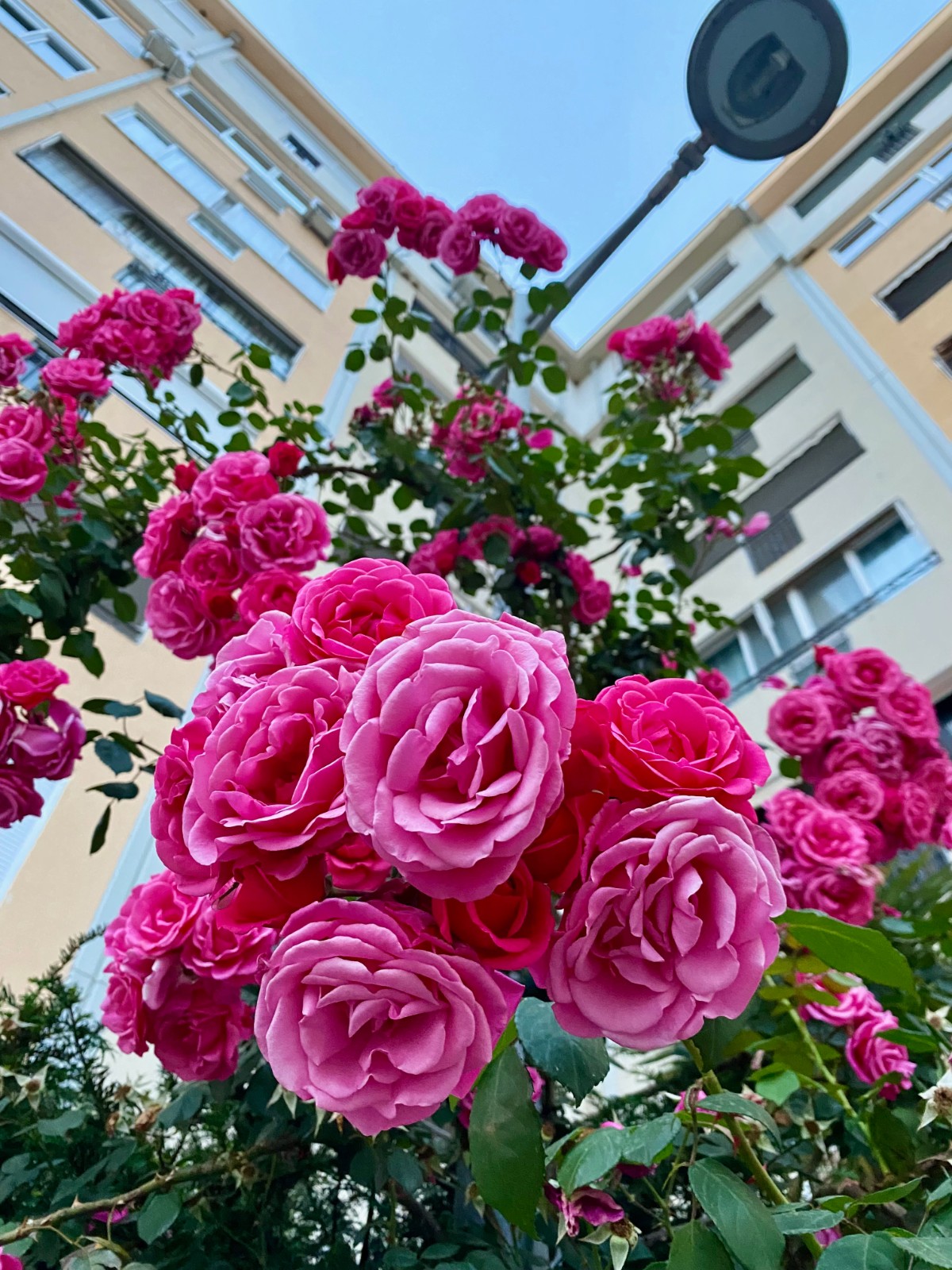
She took a step toward her terrace where, like a sky-dweller, she would be free to breathe, and almost knocked down a tall thick ceramic vase full of gigantic roses. She cursed and rubbed her toe against her other calf, still holding her cat tight with one hand, and carrying her glass in the other. Her father claimed the vase had belonged to a Roman emperor. Margo suspected her father had been duped. She had never told him that. He liked his Roman culture.
“Per aspera ad astra,” he would tell her, dropping her off at a boarding school, “through hardships to the stars.” He’d wave and vanish till it was time to transfer her to another school.
Now Margo blinked at the gold-plated card that stuck out from one of the heavy blossoms. She placed the cat down and picked up the card. It was in French. She wrinkled her nose. The language reminded her of her first school – gloomy gray building that smelled of stale water and pigeons’ droppings.
“Dad, the teachers sound like they are rolling marbles with their tongues,” she said.
She huffed, remembering that now. Her new suitor probably believed that sending her these thorny bushes across the globe would pave the way to her heart.
“Believe me, mon ami, you wouldn’t want to get that close,” Margo said.
This guy would escape straight from the restaurant. At first, he would try to bury his nose in the bowl-like glass filled with oily red wine, pretending to be savoring its smell. Then, he’d pretend some more; he’d take a call that would, of course, turn out to be a business emergency. He’d vanish before a wide-eyed waiter brought the dessert.
Tomorrow Margo would leave a note for her housekeeper to get rid of the flowers and not accept new ones.
Sometimes she wished people just talked more behind her back. It would save so much time and trouble. Nobody would try to get too close. But people were people – they sent gold-plated cards, asked pointless questions, leaned her way. They always leaned her way. She saw their wishes in the way they leaned. They didn’t dare to talk behind her back. They let the world discover the truth about her.
She did neuter her cat when she got him – a fluffy Persian ball. She called him Peach. The operation didn’t work. Nothing in his behavior changed. He kept on marking.
She recognized the sound in the hall: a stream drummed dully against a hard surface. The electric candles twisted and danced, reflected in a puddle which grew, soaking her abandoned heels.
She raised her shoulders, then dropped them. More scent had just been added to her perfume. She stepped onto the terrace to watch the city that lived below.
Black dots scurried along the sidewalks. Cars honked as traffic lights blinked, spreading blotches on wet asphalt. She watched the black dots as if they were a colony of ants: busy and anxious, restless, united and different from her. She’d watched them all her life.
“Money can’t buy you real friends,” a teacher, who looked more like a schoolgirl, said during the welcome speech. Had that young woman with a shimmering, cheap brooch tried too hard to ignore the sheer amount of wealth that stared at her from ornate padded armchairs? The headteacher pressed his hand to his mouth. Margo was sure she saw him bite the side of his index finger. Even the bodyguards stirred inside the shells of their suits, exchanging looks. Someone coughed. The teacher hurried to clarify that she of course meant the strength of friendships she foresaw forged within these ancient walls. That poor girl didn’t get the chance to add anything else. The headteacher took the lead, and no one ever saw that girl again.
Margo never found out whether any friendships were forged there. Her roommate cried every night, hugging a plush toy. The cup on the roommate’s nightstand bore the message, “Home is where my cat is.” One day, the girl refused to go to classes. When Margo returned to the room, she found the girl swaying on her bed like an upside-down pendulum, reciting French poetry. Margo rushed out of her room and called the matron. A helicopter came soon after and lifted the girl away. While Margo was at classes, someone cleared out her roommate’s things, including the cup. Margo’s father flew in for an unscheduled visit, and transferred her to another school. The new school taught in German.
“I like this language more,” she said then. “It doesn’t pretend.” She almost asked her father to take her home, to let her study in her own language, and realized with a jolt of more surprise than pain, that she could no longer pinpoint such a place on a map. The following year, they moved yet once again. Now Margo didn’t even try to learn the local language. Her father hired tutors, and that was the end to any potential friendship-forging.
“Don’t worry,” her dad said. “Wherever you go, people will like you.”
Margo wasn’t sure whether he was so confident in her, or in his money. Because, as it turned out, that young teacher was wrong. Money could buy you friends. People didn’t even have to fake it – it was a myth that they would. Their minds would naturally mold, adjusting attitudes.
“I know people will like me, Dad,” she said. “But why would I need that?”
Another sound came from the corridor. Now the stream drummed against ceramic.
“That poor vase,” Margo said quietly, sipping her whiskey.
Her father had a special company deliver that vase to her. The carriers wore white cotton gloves while unpacking it.
“This is your housewarming gift,” her father said back then.
Margo laughed.
“It’s quite cold to touch,” she said. “I’d better get a cat.”
Her eye caught a white sheet of paper, glowing on the glass coffee table. Margo unfolded the note and tilted it toward the light from outside.
“Please, consider it my resignation letter,” her housekeeper wrote. “Also, forgive me if I’m intruding, but here’s the phone number of a vet clinic that I trust. My first cat had the same problem, but it’s absolutely fixable. Kind regards.”
Margo smiled, reading this. That woman would have to scrub herself raw to get rid of the stench. Margo made a mental note to call the agency in the morning. They regularly sent new people. She sighed.
“Pecunia non olet,” her father used to say, “money doesn’t smell.”
Well, she had obviously taken care of that. Margo crumpled the note and let it fall toward the ants below.