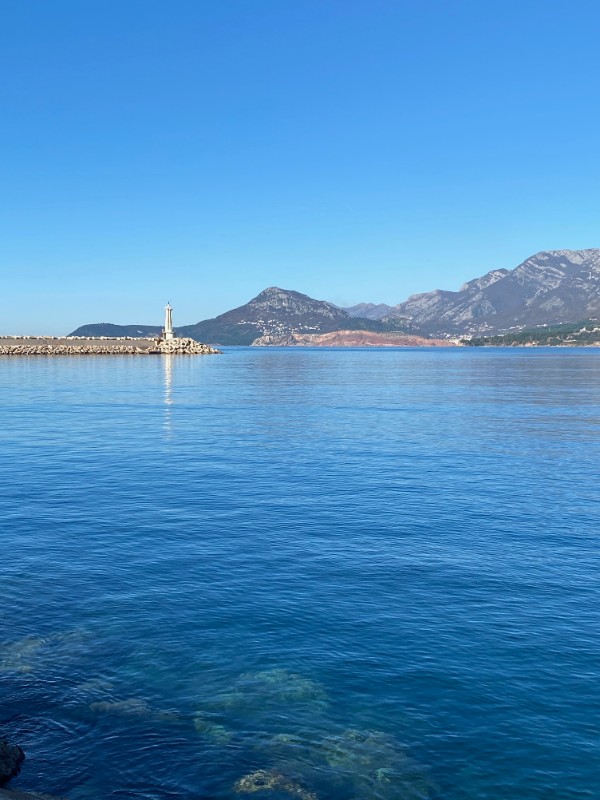
The lighthouse
Every morning Momo is awake before the sun creeps up above the mountain ridge. In summer, when the largest number of yachts rest in the harbor, this is a very early hour. Momo doesn’t mind. He doesn’t sleep well, anyway.
The person in the mirror looks like his father used to look, the sick and withered version, not the hulking bull. A thought comes to Momo. What if his son looks in the mirror one day and sees Momo? And then he shakes his head. No, this is not possible. His son doesn’t know what Momo looks like now. This is a good thing – the boy was always too easily upset.
Momo glances at the mountain through the small bathroom window. His eyes have had a lot of practice looking at distant objects. That’s why he can see the limestone getting brighter as the sky ripens from pale to blue. The sun will be here soon. Momo throws on his white cap and hurries out, racing against the sun to get to the lighthouse first.
On the town streets, Momo walks past old people with hiking poles, joggers, dog owners (a funny new fashion that one – to keep a dog indoors).
He passes the school his son used to go to. He passes a parking lot with a basketball hoop hovering above the cars. The hoop was installed decades ago when there were barely any cars in town. Kids played here after school. His son used to shoot hoops too. Even after he finished school, he’d still come down here to blow off steam.
It was so easy to drive his son mad. All it took was just a few words and the door would bang.
When Momo passes the yacht school, he looks away. “You learn to steer a yacht, you’ll never go hungry in this town. Someone is always hiring,” he said to his son back then. The irony.
As he gets closer to the harbor, he starts recognizing people; mostly fishermen. They also make their way to the lighthouse, carrying buckets and fishing rods. Some push their bicycles with folding chairs mounted on the handlebars. The fishermen say hi to Momo; they know him well. They have been sharing the same rocks for years. Momo reaches the lighthouse and presses his palm against its familiar metal side.
“Anybody headed out yet?” Momo asks. The fisherman next to him shakes his head, putting a cigarette between his teeth.
The sun finally catches up. Its rays are warming Momo’s back. The sea wraps itself in gold. The infinite blue surface stretches all the way to the horizon, becoming one with the sky.
Then, from the harbor, gliding between the lighthouse and the breakwater, the first yacht of the day appears.
Momo shields his eyes like a captain and squints at the yacht. The flag is French.
“Adieu!” Momo shouts then, waving his white cap. “Bon voyage!”
It takes a moment for the couple on the yacht to understand what’s happening, but then they wave back. Their “merci” carries far across the peaceful water. What a peculiar story, they might think. They’ll share the story later at a dinner with friends somewhere on other shores. They’ll pass on Momo’s words. Good. This is exactly what Momo has planned.
As the day unfolds, Momo will bid farewell in Spanish, Turkish, Greek. He’s learned to say good-bye in twenty languages. He knows twenty ways to wish someone a happy journey. When the sun glares from its zenith, the fisherman will break his bread and cheese in half, and give one half to Momo. Momo forgets to pack his lunch. He often forgets to eat.
On land, the tourists smile when they notice him. They take pictures of Momo – he’s the main attraction. They send those photographs through the air. Momo’s face travels around the globe, reaching its most distant corners. Good. This also fits Momo’s plan. Momo waves and smiles at their glossy phones. He doesn’t smile at locals.
The locals look at him like he’s dying, like his plan has already failed. The condescending tone, averted gazes, prolonged handshakes – they think they know what happened. Like hell they do. Even Momo isn’t sure what happened. He wasn’t even rough that day. He didn’t even try to hurt the boy. Momo was a good father, at least a better one than he himself ever had. The boy was just too impressionable, too easily offended. Sailors are supposed to have thicker skin.
When the door banged that night, Momo didn’t even flinch. He was expecting it. He was victorious, knowing he’d won again. When his son didn’t return that night, he felt prepared for this escalation. It was the following night that Momo called the hospital and then the police, but neither had his boy. The sun was still deep behind the mountain when Momo went to search for him. He passed the school, the empty parking lot. Nobody was hurling the ball into the hoop. He found no traces of his son. Eventually Momo reached the lighthouse. There, a fisherman told him he had seen his son board a yacht. The fisherman couldn’t remember anything particular about the yacht; it was just one of many boats that docked here to refuel, get repairs done, and find an extra pair of hands to do some work on board. His boy had been trained just for that. And so off he had sailed with them.
In all these years, his son has never called him or sent a message, not even a few words. So Momo sends his words instead. He never had much good to say, so his message is short. This way it’s easy to remember and light to carry across the infinite blue surface to the most distant corners of the globe. “Goodbye and have a good journey.”