Music for the river spirit
Take your children to the river spirit, the villagers used to say, and do not fear for them.
The river was their hidden treasure, the deep emerald shine, known only to those whose roots sprouted from this soil several generations back.
Sure, there was the river’s fastest stretch, known to any visitor who watched it burst between the rocks at the beginning of the village. The river quenched the thirst of passers-by, the villagers and their fields. But the quiet, shining, emerald stretch of the river was high up and deep in the jungle. Anyone who wished to reach it had to skip on shiny pebbles across the twisting streams and sticky bogs to reach the spot.
It hid among the trees, whose leaves danced like green coins in the wind while damselflies fluttered their wings, plated with sapphire dust and gold.
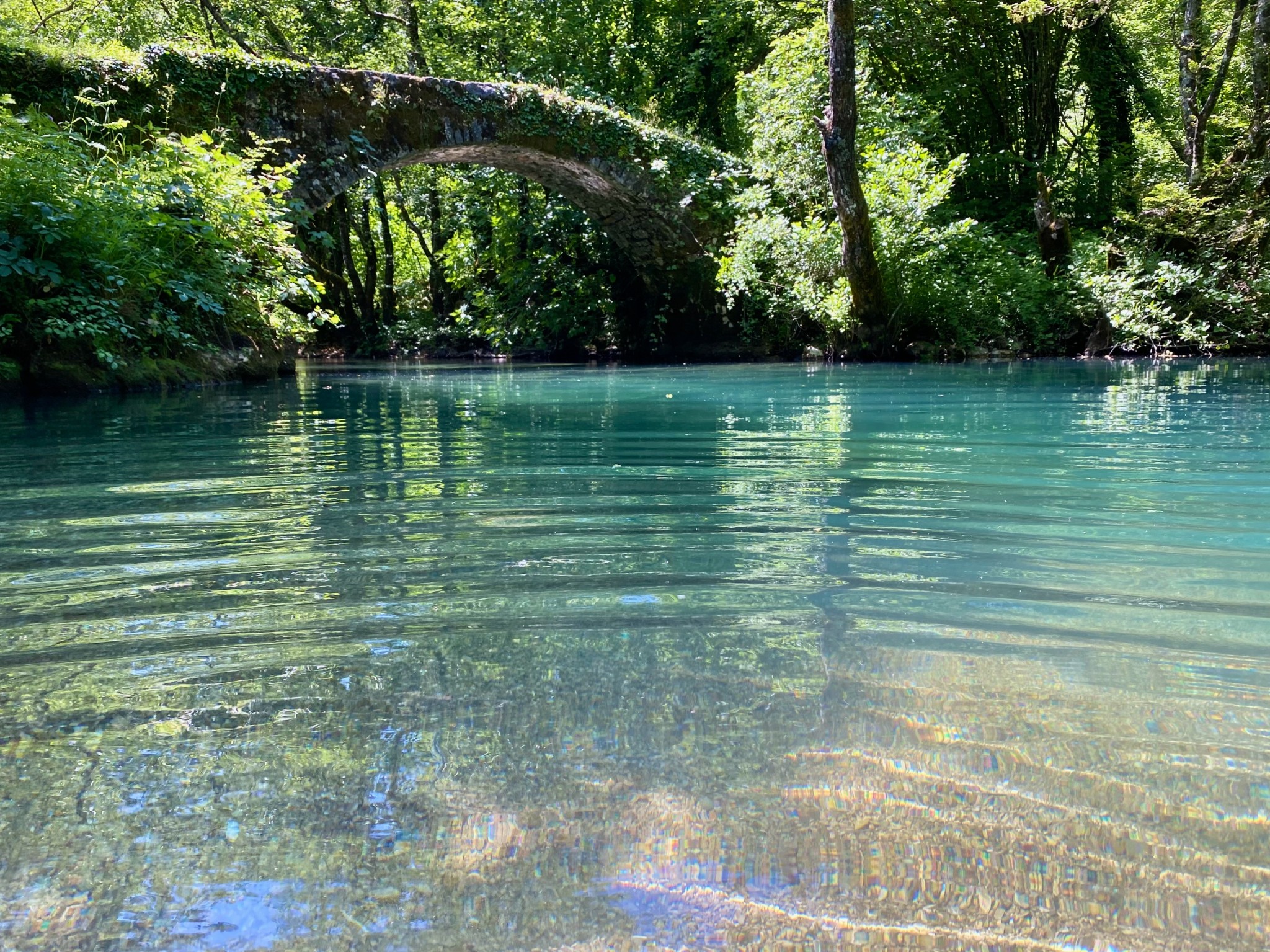
The river calmed to crystal clear near the old stone bridge which curved above the water, forming a perfect loop with its reflection. Golden ribbons of light slid over the boulders on the bottom.
There, swimming through this hoop of the bridge toward the reeds down the stream and back, lived the river spirit.
Nobody knew exactly where she came from. Some said she once was the daughter of a king, but when it was time to marry, she refused the prince her father had chosen for her. So the king banished her from his kingdom and cursed her to become a river spirit forever locked alone within the river.
The kings and princes were long gone, and so were their kingdoms, and their curses. The river spirit was rarely alone these days. The villagers never saw her, but knew that she was there. They knew this for two reasons.
The first one was that the spirit stole things. Every time someone would undress for a dip after climbing the hill on a hot summer day, she’d snatch their towel, shoes, or belt.
“Give them back,” the person would yell barefoot, or dripping wet, or with their pants falling off. She would giggle, her laughter the sound of water babbling under a rock.
“What use are they to you?”
And she would laugh some more. They were right: she didn’t need those things. Later, she’d send these belongings floating down the stream. Shoes, belts and towels would wash up in the village, soaked and ruined at the edge of the fields. She simply loved to hear the noise that people made while searching.
Another reason the villagers knew of her presence was that no one ever drowned in that part of the river, regardless of how hot the day was or whether the swimmers were exhausted. Even those who didn’t know how to swim, would come to the spot and learn to float. She would hold them. She didn’t let anyone drown. That’s why villagers brought their kids to that stretch of the river. That’s where generations upon generations learned to swim.
The boy, his older sister and their grandmother arrived early in the season, when the path was still soggy after the rains, and the river filled with water from melted snow.
“Teach him to swim,” the grandmother said, leading the boy to the water’s edge.
He rolled his pants up and pulled his socks off. He ran into the water just to test it and shrieked when it reached his knees.
“It’s cold like ice. Will you swim with me?” he asked his sister, but she shook her head.
“Swimming is boring,” she said. “I prefer to play.” She took out a flute from the deep pocket of her long dress.
Her brother left his clothes on the shore and ran toward the bridge to jump from it for his first swim. The grandmother retreated to a wooden bench, lowered herself under the shadow of a tree and opened her book. Then, glancing at the boy’s shoes, she rose from the bench, and hurried back to the shore to pick them up. No heist today for the river spirit.
The river spirit huffed. She would try her luck with something better than this boy’s shoes. She had her eye on that long reed stick that the girl clasped in her hand. The reed had a neat row of punctures on the top, and it shone golden under the early spring sun. But for now, the spirit glided toward the bridge to catch the boy. She stretched her hands up, prepared and waited. The sound of the flute arrived and transformed the air.
Everything the river spirit ever knew, or could at all remember, stopped existing. Birds’ songs died out – she wasn’t sure that birds still lived. She couldn’t care. The damselflies fluttered around her, disturbed, haphazard. She waved them off. What was that substance in the air, that noise? As if water became one with wind and was now trembling in her ears. Where was it coming from? She turned to the sound and saw the girl. The girl was playing. The river flowed. “Here I go,” the boy had warned her, but she couldn’t hear him. She didn’t want to. She floated toward the sound.
Reaching out her hand, she almost grabbed the flute. The flute produced a sharp screech, and the girl pulled the flute away, hiding it behind her back.
“What are you doing?” the girl asked, staring at the river spirit who looked like a girl not much older than she was, but all green and draped in weeds. “Where is my brother?”
The river spirit spun around, and they all heard the splash. The boy went into the water and under. He didn’t swim up.
The grandmother dropped her book and rushed to the pebble beach.
“Where are you?” the grandmother screamed, and nobody knew whether she was calling out to the boy or to the river spirit.
The girl jumped into the river, and waded through cold waters toward the bridge.
“Get him,” she gasped. “What are you waiting for? Get my brother back.”
The river spirit slid away and disappeared into the reeds. Several long moments later the boy floated back, up the stream.
The boy crawled onto the shore, weeping, coughing and spitting.
“I’m never swimming in this stupid river,” he screamed.
“Why have you done that?” the girl hissed to the river. She helped her grandmother gather their things, slid her flute into the pocket of her dress, and they were gone.
The spirit hovered above the water like a cloud of mist. She bit her lip and clenched her fists. The damselflies surrounded her head like myriads of unwanted thoughts. She ignored them. Instead, she puckered her lips and tried to whistle. It didn’t work. She tried to hum. It didn’t work either. The magical flute sound wouldn’t come. She growled and swatted at the damselflies. Slapping over the water toward the marsh, she snapped a few stems one by one. She blew into them, poked holes in them with her fingernails. Eventually, she managed to produce some whistling sounds, but nothing like the sound of the flute ever came out.
She rummaged through the marsh till sunrise, when there were hardly any stalks left standing. Every time she snapped a new plant and failed to turn it into a flute, she hurled it into the water and grabbed another one. The water in the river became murky, gurgling. It carried the broken and torn plants. They piled up into a thick dam, so in the morning the villagers found their fields dry and their wells empty. While the villagers stood, scratching their heads among their harvest that was now doomed to wither, the river smashed its own dam and gushed into the village. It drowned the fields, granaries and even those houses that had been built low in the valley. People ran out, carrying their pillows, baskets and babies over their heads.
The girl slipped out through the open window, barefoot, with her hair undone, and nothing but her nightgown on. She hadn’t forgotten to take along the most important thing – her flute.
She crawled up the mudded path, slipping at every step and sliding down. But every time she held her hand high, saving the flute.
She reached the river bruised, bloodied, covered in crusts of mud, but what she saw looked even worse.
There were no plants left around the river. There were no birds, no damselflies, only the bubbling, fierce brown water.
“What have you done?” the girl whispered. A shadow slanted on a tree stump across the river. “This is too much,” the girl said.
The figure tilted her weed-covered head and turned around, swaying slightly as if crying or saying “no”.
“Here’s your flute,” the girl said, putting it down onto the pebbles near the shore.
The shape rose slowly, long and green, like a tuft of torn grass stuck between rocks in a current. Hesitating, the river spirit left her tree stump and floated toward the girl.
The girl saw the green hand, not larger than her own, poke through the mist. It grabbed the flute and carried it back to the other side.
After a few days, the water settled down. Deep ponds, puddles and swamps in the village were reabsorbed by the land. The river cleared. The plants grew back. But nobody ever came again to learn to swim there in the river.
Only the boy sometimes visits. He sits on the bridge, swaying his legs. He’s no longer a boy. His sister has grown up too and left the village. He still can’t swim. He doesn’t even try. Instead, he listens to the flute.
“She would have loved your music,” he says, “if she were around.” He watches the golden ribbons of light under the bridge.