Mira is going to the sea
She was turning into a fish, she said. This had been going on for days. Couldn’t he see? Couldn’t he smell it on her? She smelled of the sea. She found two fish scales under her pillow!
Mira jiggled her bracelets above his head. Her voice alone would not get his attention. Tomo raised his newspaper, pulled his head in – a tortoise retreating into its shell.
“Just look at them,” Mira said, slapping two fish scales on the paragraph that he was reading.
Wet circles started to engulf the words together with his peaceful morning. Tomo sighed and focused on the scales. They were peculiar – unreasonably large. Not that he knew much about fish, not before it ended on his plate, scaleless. Tomo’s mind wandered back to the last time it happened – in early March, on his birthday. To celebrate, they drove down to the village restaurant. The old stone wall clung to the cliff above the sea. It used to be a fortress in its days of glory. Now, draped in nets, lifebuoys and anchors, the fortress fed sunburnt tourists its overpriced and equally burnt sea fish.
In March, the tourists were still scarce and not that burnt, the same was true for fish. You had to call in advance to make sure the fish was on the menu. The restaurant couldn’t afford to store it off-season. And Tomo liked it, the way he liked all discomfort that meant fewer people.
The winds were still strong in March, beating against the waves below, biting their tips off and throwing them in the air like shards of broken glass. As the sea spray landed on their plates, Tomo joked that the kitchen needn’t have salted his fish. Mira didn’t laugh. She poked at her boiled potatoes and looked away toward the sea.
Tomo used to think that Mira, too, liked being far away from people. And she did. Just not the way he thought.
“Come back to Earth.” Her voice pulled him back. The two fish scales were still there, shining on his newspaper. Tomo shrugged.
“They’re probably from the fishing competition,” he said, scrubbing them off.
“The what?”
“The fishing competition,” Tomo repeated as if it was her hearing that was the problem. “My newspaper is ruined,” he added, hoping it would guilt her into silence. It didn’t.
“What fishing competition, Tomo?”
“It’s from the market,” he said, poking his finger through the wet paper. “They’re selling off the surplus from the fishing competition. The scales must have come from the wrapping.”
Mira looked at the scales with horror. Seafood was never something she enjoyed.
“Is this where the smell is coming from?” she whispered.
Tomo pulled the air in through his nostrils.
“It’s the smell of the sea,” he said. “It drifts in on warm days like this.”
“The sea is five kilometers away, Tomo.”
“So you keep saying,” he replied.
She was supposed to drop it after that, to go to her rooftop. There, she’d pile her cushions in a pyramid. Perched up like a seagull on a mast, she’d watch that blue and golden surface reflecting sunlight all the five kilometers away. By midday, she would go back inside to cook their lunch. The onions would hiss and spit in oil while her mind glided through the thick water that looked like liquid glass and felt like silk.
A trap. Their conversations were a trap. Regardless of who was the one to start, they both would end up here, clawing themselves into the trenches.
Mira spun around to head for her roof. But then she shuddered, screamed and threw her arms up. It looked like she had tripped – she tumbled down like a felled tree.
Tomo rushed to her and tried to pick her up, but she felt heavy.
“What’s going on?” he asked.
“My feet are turning into flippers,” Mira said, slapping her bare feet against the floor.
He let go of her shoulders then. That was too much. Her constant complaints – he had grown used to those, he could stand them. But this scene here – it was a whole new level. He had to handle this correctly, or she would add it to her repertoire.
“Will you get up now?” Tomo asked, keeping his voice as steady as he could.
“I can’t get up. I’m a fish. I need the sea,” Mira said, thrashing on the floor.
“You need a doctor,” Tomo said. “You have heatstroke from all that sitting on the roof. You’ll have to stop that.”
He said the last thing to shock her back to normal. At least the slapping stopped. It was now quiet.
“Go get the doctor,” Mira said, her tone suddenly calm, distracted. Later, looking back, Tomo would think that this was the moment she came up with her plan.
Tomo was cornered. He had to go and fetch that drunk, or Mira would figure out he bluffed about the doctor.
“Fine,” he said, getting up from the floor.
**
He rolled down the windows of his car. The road puffed dust as the gravel grumbled. Tomo would hear the sound for all the seventeen kilometers that led to the sea. The sea really wasn’t so far away, not more than five kilometers, but –
“By air, Tomo! By air!” Mira screamed when she had learned where he had bought the land.
“It’s closer than where we are now,” said Tomo. Back then they still lived in the city.
“I can’t drive thirty-four kilometers across the mountains every day!” Mira said.
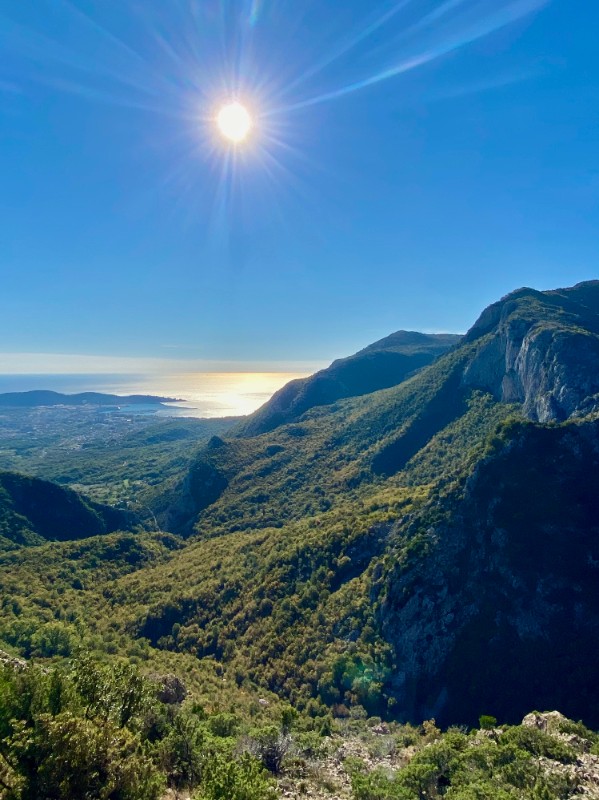
“You’ll see the sea from home,” Tomo said, gesturing at the view that lay before them. The distant sea sparkled like tinsel.
“I’ll be like a dolphin in a coastal dolphinarium – feeling the sea, unable to reach it.”
So Tomo got her a new shiny bike.
“There is a nice trail through the forest,” he said. “It’s a shortcut straight down to the fortress.”
Mira stared at him.
“You want me to cycle down the forest trail?” she asked.
Tomo looked at the bike and shrugged.
“All right,” she said. “Suppose I do that. Then what? How will I cycle back up? Or is it a one-way trip?”
**
The doctor’s name was Josip. His house was on the shore, but he spent most of his time in the village restaurant. The barman, as a form of health insurance, treated Josip to free brandy – the self-prescribed medication that Josip claimed helped his neurosis. The neurosis had cost Josip his practice in the city, although Tomo suspected it was the medication.
Josip was the first doctor the village ever had. Broken limbs, infected cuts, a cough that wouldn’t go away – the villagers came to Josip with everything. One day they brought him a cow.
The cow had wandered into the restaurant. The barman tried to chase it away but scared it. The cow ran too close to the edge of the fortress where a large arched window used to be. Now it was just a gap for tourists to take photos through. The cow flew through the gap and down to the sea.
It was still alive when they fished it out. They rolled it to Josip in a cart. The owner begged – he couldn’t afford to lose the cow. So Josip rolled his car out of his garage and put the cow in instead. When the owner returned for his cow the following morning, it was dead.
“Such injuries are not compatible with life,” said Josip back then, but someone started a rumor that it was Josip who had killed the cow. Mira said it was Tomo who started it. The argument had ruined his birthday dinner back in March.
“The guy is not a vet,” Tomo said, waving a piece of fish on his fork. “He had no business touching that cow.”
“Why don’t you leave him alone?” Mira sighed.
“Because he’s a liar, Mira. He tells everyone he ran the main hospital in the city. Maybe he just swept the floors. Doesn’t that bother you?”
Mira turned away from him, watching the sea through the gap in the stone wall.
“No,” she said. “People lie about what they can give you. It happens.”
Tomo put his fork down carefully on the plate.
“How do you do this?” he asked.
“What?”
“How do you turn everything into an attack on me?”
“What did I say?” asked Mira.
Tomo shook his head and picked up his fork again. “Forget it. It doesn’t matter.”
“Right,” Mira said, her voice flat. “Everything matters unless it’s something that I say.”
**
Tomo shot off the gravel and onto the old cobblestone street. The car bounced over the polished stones. He slammed on the brakes, barely missing the tables outside the restaurant.
“You must be kidding me,” he said, spotting the sign on the closed doors. There were no words on the sign, just a drawing. It showed a smiling fish.
The whole village was down on the shore under the fortress. The rocks, usually left to seagulls and trash, became a crowded amphitheater of people eating, drinking, laughing. A haze of voices hung in the air. Tomo shuddered. This was exactly what he avoided by living on the mountain.
The barman was here too, hopping from rock to rock with a tray of coffee. He must have carried his gas stove down to the shore.
“Coffee?” the barman asked, balancing the tray.
Tomo shook his head. “Where’s Josip?”
The barman pointed toward the shoreline. Down among the contestants stood the village doctor, cap sideways and shirt unbuttoned, clutching a fishing rod. Hearing his name, Josip looked up.
“Oh, look,” Josip hollered, waving at Tomo. “My nemesis!”
Tomo froze, harpooned by the public gaze. There was nothing personal in the way these people hoped for scandal – just the age-old boredom of a small place. Still, Tomo despised them for it.
“Come here, nemesis. Join me,” Josip yelled over the heads of the crowd. “I didn’t know you fished.”
For a heartbeat Tomo hesitated, imagining how good it would feel to simply go home now. He’d tell Mira that Josip was busy at the competition. But leaving with all these eyes pinned to him would lead to even more talk. The only way to stop making a scene was to quickly close the distance between them.
“Caught anything?” Tomo asked, climbing down the rocks.
“Not a thing,” Josip said. “But I dreamed of a large fish today. So it might still appear.”
“I didn’t know doctors had superstitions,” Tomo said, focusing on the water just to avoid the crowd.
“Well, maybe I’m not a real doctor,” Josip laughed. “Maybe I just sweep floors.”
Cold rolled down Tomo’s spine as if someone had poured seawater behind his collar.
“What do you mean?” he asked.
Josip shrugged and spun the reel.
Tomo heard his pulse in his ears.
“Did Mira talk to you?” he asked, careful to keep his voice steady.
Josip nodded. “She did.”
Tomo thought about Mira alone back at home. The image of her slapping her feet flashed through his mind.
“Did you give her anything?” Tomo asked. “To help with her state, I mean.”
Josip sighed.
“How do you help a fish that’s out of the water, Tomo?”
Tomo grabbed Josip by his shirt.
“Careful,” Josip said and winked. “People are watching.”
Tomo wanted to yell, but words stuck in his throat. And then someone else screamed. For a moment, Tomo thought they were shouting at him. But nobody was looking at him. The crowd was gazing at the sky.
There, from the wall of the fortress, Mira was flying toward the sea. The back wheel of her bicycle caught sunlight. It sparked, shimmered, and sent golden rays down onto the crowd below.